Showing posts with label patterns. Show all posts

Wednesday, February 27, 2013

Pattern design for beginners

Have you been adjusting and altering your patterns to the point where they are now something new? Do you have visions in your head of the perfect garment and think you might be able to create a pattern for it? How would you even begin such a project? Well, I have been doing just this and have gotten to the point where I am now dabbling in pattern design.  I have nothing to share at this point, but here are some of the resources I have been using. Now, of course, you could go to fashion design school and learn all of this but since there is not one near me, I embarked on my online learning experience.

1. Pattern design books. 
  • Metric Pattern Cutting for Children's Wear and Babywear is, apparently, one of the standard textbooks one must have if pattern design is in your future. This is the fourth edition of this book and it is available on Amazon both new and used.  I found this book to be very helpful in understanding how measurements work together with design.  It does refer only to metric measurement, so that may take some getting used to if you don't use Euro patterns.  This book is not easy to use for the beginner, I won't kid you. But, it is invaluable.  The author, Winnifred Aldrich, also makes versions for menswear and women's wear. 
  • How to use, adapt, and design sewing patterns is another good book to read.  I got it from our local library but then decided to also buy it on Amazon. It has chapters on altering commercial patterns, designing your own patterns, great information on techniques and tools, and, most importantly, a huge assortment of pattern blocks for you to use.  What are pattern blocks? Read on!
  • Some other books to consider are: Patternmaking for a perfect fit by Steffani Lincecum, The complete photo guide to perfect fitting by Sarah Veblen, How to make sewing patterns by Donald McCunn, and Sewing Couture Techniques by Claire Shaeffer. These, and more, are for sale on Amazon and may also be in your local library.  I also found some great vintage pattern design books at local used book stores.


2.  Pattern design blogs
  • The Fashion Incubator is a great place to start looking online for information on pattern design.  Kathleen Fasanella not only runs the blog but also writes books, runs a forum and has other products, services and resources about fashion and pattern design. I do not belong to her forum, so I cannot comment on it.  I do find her posts about pattern design to be very helpful, such as this one on "how to check the accuracy of graded patterns."
  • Carla Crim, from The Scientific Seamstress, who makes awesome patterns, wrote a three part series on making epatterns for Sew, Mama, Sew. They are a beginning look at what it takes to design a pattern.
  • Burda has some resources for pattern design, such as this list of tools you need. You are only as good as your tools, so definitely plan on getting at least a few new ones.  I have to say that my new set of French curves makes me very happy.
  • You definitely do not need a lot of fancy tools to just begin to make a pattern for yourself or your family. Look at what Katy did at Sweet Verbena. Google around and you will find more!

3.  Software  - as far as I know, there is not software for the home user that will do all the work of pattern design for you. You can, however, use these illustration software products to draw your own.
  • Inkscape is free. Don't ask me how to use it. I couldn't figure it out.
  • Adobe Illustrator is not free, but you can probably find a class at a local community college to help you learn how to use it. That is what I am currently doing!  
4. The last thing you need is some lovely friends who can answer dumb questions. If your friends don't know pattern design, you can join me in the journey! I would be happy to try to answer our questions or find someone who can.

Here's a sneak peak of what I am up to!


Thanks for reading!


 PS If you made it this far, I will tell you what a block is for!  A basic block is a drafted pattern that has been perfected to fit the body precisely.  After it is tested, it becomes the base for other patterns. You can take that basic block and use it to build other patterns. Like, if you have a basic bodice block, you can add different sleeves, sash, skirt types, etc, and build more patterns on that bodice block. This is not to be confused with sloper.  A sloper is a pattern without seam allowance. Fashion incubator explains it better.  


Saturday, January 26, 2013

The Digital Millenium Copyright Act and the home sewist

Are you a home sewist who buys pdf pattern files? Then this post is for you.  Did you know that when you buy and download those files, you are buying a copyrighted pattern from the designer?  You are given the right to print out that pattern but you are not give the right to make another copy of that file. Meaning, you are not legally allowed to email that file to a third party.  So, sending that file to your husband to print out for you at his office is not allowed.  Buying the file and then emailing it to a friend as a gift is not allowed.  Trading it with a friend for a pdf pattern she has is also not allowed. Why? Well, in a nutshell, because you are making a copy of the file to do this sharing and you are only legally allowed to have one copy.


Now, let's back up a second. What does all of this mean and is Kathy sure of what she is writing? Well, first of all, I am not an attorney.  On a good day I feel pretty smart, but some days I feel darn right average. Still, I do my best to understand my topic and I  have done some reading and I wrote about this topic once before, here.  That blog post was about the idea of using a pattern you purchase to sew a garment you then sell. 


This post, however, is about sharing with others the pdf patterns you purchase.  Copyright refers to the exclusive right to make copies, license, and otherwise exploit a literary, musical, or artistic work, whether printed, audio, video, etc.  When someone designs a pattern, they can copyright it to protect it. When you purchase a copyrighted work, such as a book, a sewing pattern, the lyrics to a song, etc, you will see something like this written on the document: This document is protected by copyright laws and any reproduction of it, including electronic transfer to a third party, is strictly prohibited.  That all means that you cannot share the pdf with anyone. Period.  


Now, you may think that it is not really THAT big of a deal to share a pdf pattern between friends. With paper patterns, this is a common practice.  But, here's the difference.  When you share a pdf pattern, you still keep a copy of that pdf file on your harddrive. Now there are two copies for the one purchase price.  You could do this ad nauseum, sharing this file far and wide, and the artist who created that pattern could potentially lose out on dozens of sales. You are taking money away from the artist when you share this file.  It doesn't matter if it is a book or a piece of music or a sewing pattern.  The laws are the same. If the article is copyrighted, it is protected by law from being shared electronically. 


And, in 1998, this sharing of files became an international issue. In 1996, a group within the United Nations called The World Intellectual Property Organization ratified two treaties: the WIPO copyright treaty and the WIPO performances and phonograms treaty.  Two years later, then US President Clinton signed into law the Digital Millennium Copyright Act (DCMA). You can access a copy of this act here.  The DCMA criminalizes sharing of copyrighted materials and production of means of sharing them.  Generally, you are infringing copyright if you download or store copyrighted materials on your computer without the permission of the copyright owner, unless fair use or another exemption under copyright law applies. Most downloading over the Internet of commercially available copyrighted works, such as music or movies or sewing patterns, through file sharing systems is illegal. You might recall that, a few years back, Napster users were found guilty of sharing files. Many fines and jail times were doled out.  For sharing music files.  

So, the next time you purchase a pdf sewing pattern file, keep it for you and you alone.  And remember that these laws apply to all sorts of files, including photo sharing!  


Some further reading:


Wiki, of course, but remember that it is Wiki and don't take it as gospel.


PS All patterns pictured here are pdf files I purchased.

UPDATE!

 It has been brought to my attention that some people are truly stuck with no way to print a pattern at home.  So, what options do you have? Well, that is a very good question and I would recommend you write to the pattern maker and ask their advice.  I don't have a good answer that is going to work for every situation.

PPS I certainly did not mean to offend anyone with my comment that I am smarter than the average busy bee mama.  I apologize.


 UPDATE #2!

Backing up your files is allowed!

"Systematic backup practices do not fit the structure of section 117, which is limited to making a copy of an individual program at the time the consumer obtains it. It was argued that such a discrepancy between the law and commonly accepted practices undermines the integrity of the law. Such a fundamental mismatch creates the perception that the law need not be literally followed, thereby creating a slippery slope. "  

http://www.copyright.gov/reports/studies/dmca/dmca_executive.html


Friday, January 18, 2013

Keeping it real

Have you ever noticed that bloggers tend only to share pictures of their home when it looks it's best?  I don't doubt for one second that those pics do not show the reality. Creative people tend to not make time to keep things clean.  They are too busy being creative!  So, in what does my home look like on a daily basis, when I am deeply involved with a project? Here's a tour:


My daughter's desk is where I usually do some of my sewing. Hm, how am I going to get anything done on that?  I have three choices.  Organize it neatly, toss it into a box for her, ignore it and find somewhere else to work. Hm....decisions.


I have three cats.  They hang out with me while I sew, create, draw, read, play on the computer, or just hang out in the family room/craft room.  This one wants some butter.  I am not going to show you the family room. It is currently piled high with fabric at one end and legos at the other. There is a couch, a drum set, and three cats in the middle.
 

We take our shoes off when we come in.  We need a shoe rack! LOL


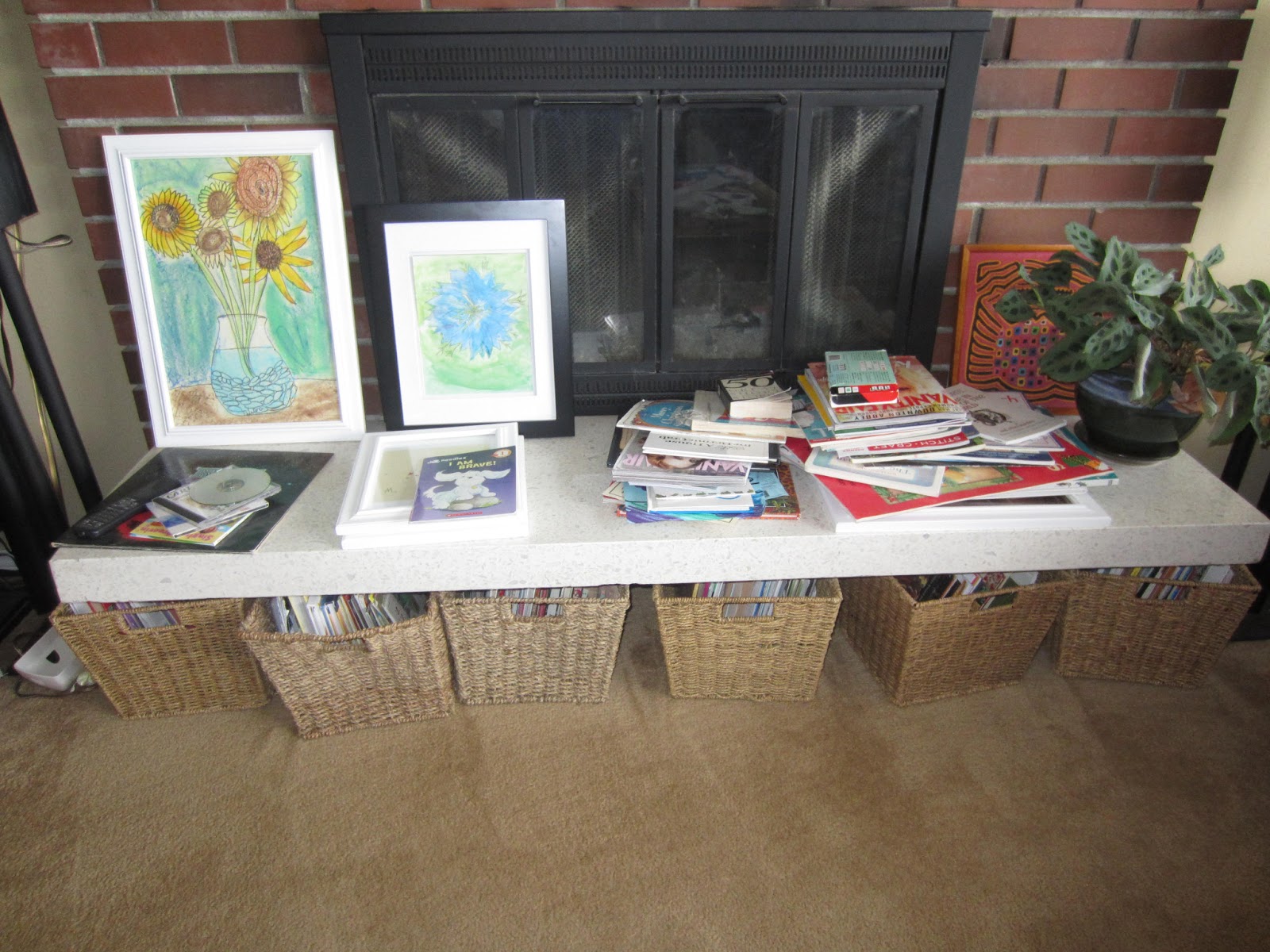
I framed some of my daughter's art but have not hung it up yet. Books are supposed to be in those baskets, under the mantle, but people don't follow my program around here!!!
 

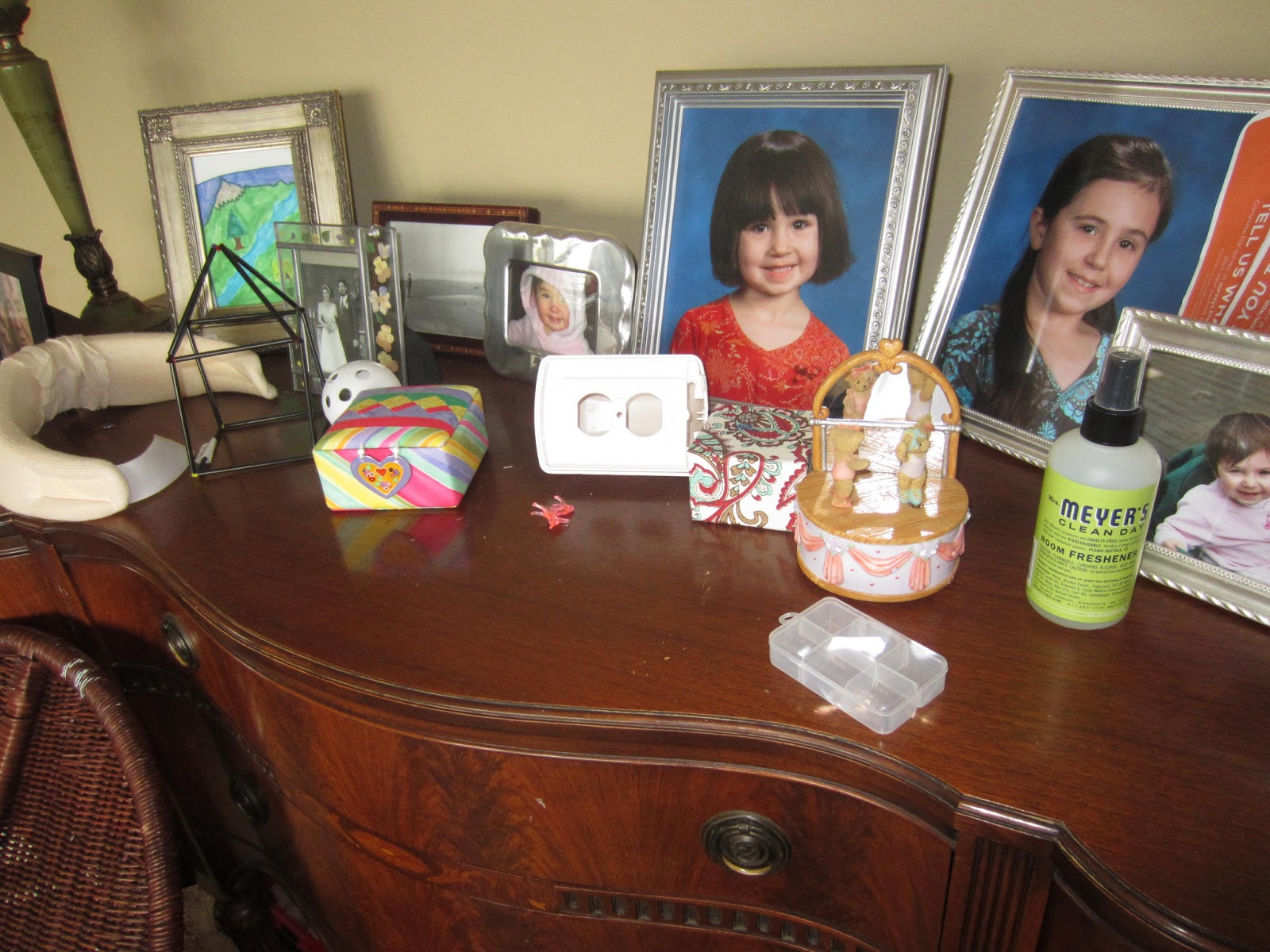
I inherited my grandmother's lovely mahogany dining room set but my kids prefer to use the buffet as a landing pad for all their stuff. That wee box in front? That is hubby's flies (for fly fishing). Why are they there?  The neck brace is for me. I have had vertigo off and on and need it when I am dizzy, to keep from turning my neck to the left.  My girls are 5 and 9 so I thought it was time to take the electrical outlet covers off. They don't need child proofing anymore. But what to do with them, other than stash them on the buffet? 
 

I love my youngest daughter's room, which I lovingly decorated for her a couple of years ago.  I ordered those flowers from Etsy, custom designed by me, and painted them myself.  And then she stuck her art on the walls and is now using a boot box as additional doll bedding.  So much for decorating!  Oh well, it is cute.  


This is a closeup photo of my kitchen floor, which is white vinyl. Who puts white vinyl flooring in a kitchen?  Well, the retired folks who used to own our house. They had no pets or kids so I guess they did not mind it.  But, as you can see, it needs a good scrubbing and there are constantly black hairballs floating around.  My husband says it is functional enough and doesn't need replacing. We need a new fridge first.  Sigh.


Here is the owner of the fur that falls off and becomes hair balls.  Boon is an American labradoodle, which just means fancy mutt. He sheds.
 

He likes to back talk to me!  He is complaining right now.  He wants to go for a walk.  


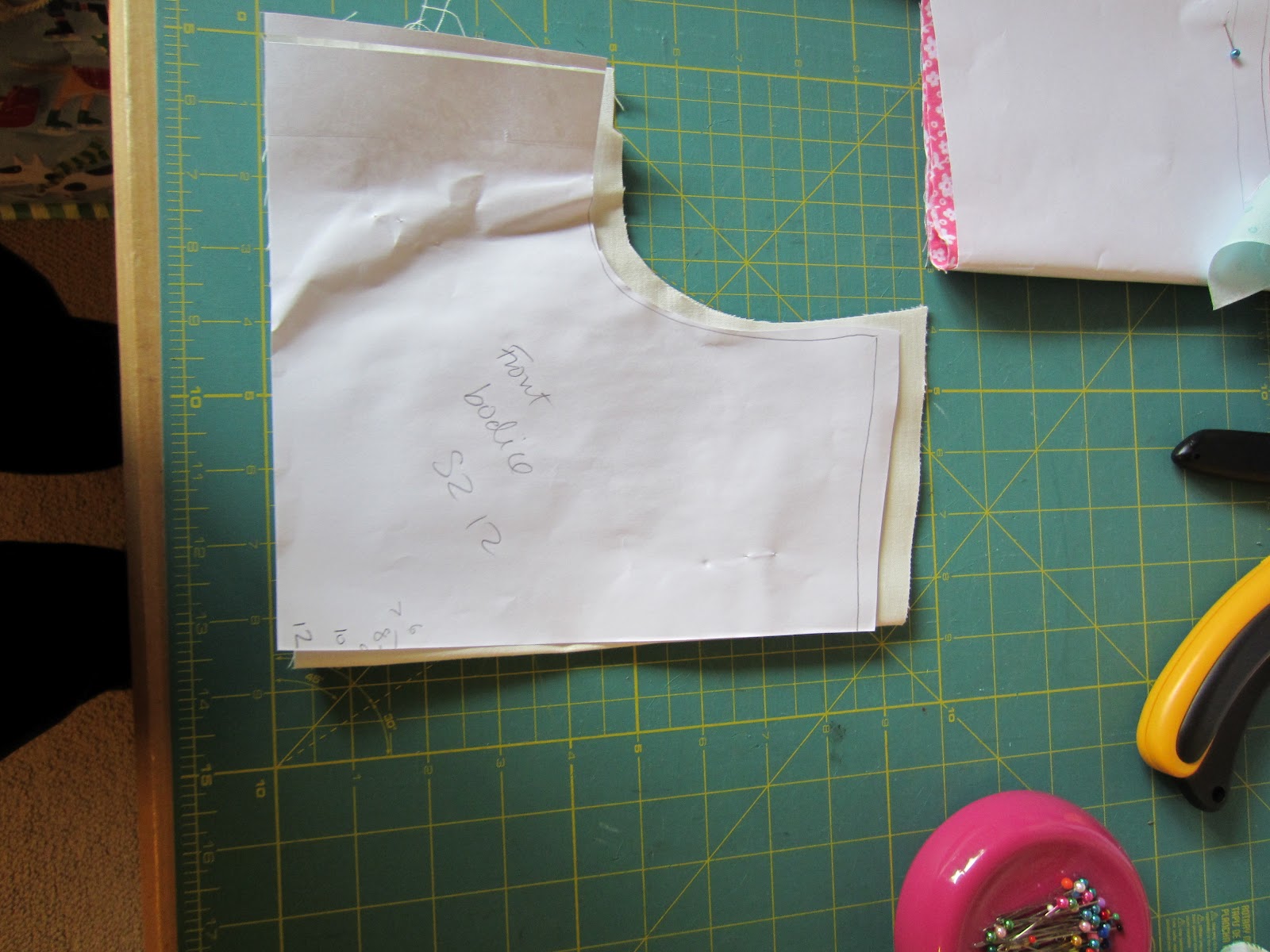
And what is keeping me occupied so much that I am ignoring all of the above?  Why thank you for asking! I am designing my own patterns.  I am very excited about it. There is one piece above. That is part of a top. I am also designing a dress and a bag.  

I will keep you posted on their progress!!


Thursday, September 6, 2012

Back to sewing! First up, Nelle goes to sea!

After a lovely summer of travelling around, with my girls, visiting family, it is nice to be home and back into a routine. That includes sewing!  School has already started for my nine year old, and I have made some things for her to wear out of some beautiful Free Spirit Karavan Knits. I will share that later. 

First up for sharing, I am excited to finally try the Brownie Goose Nelle pattern.  Amy, of Brownie Goose, is a sewing friend from Facebook and I have been waiting for the perfect thing to use for this feminine little dress.  I found it in the Out to Sea Fabrics from Sarah Jane.  I particularly love the Ship Flowers in Navy.   This was an easy pattern to sew and the directions are great. I highly recommend it.  I plan on making more of these!  I hope my cutie pie wears this tomorrow for her first day of kindergarten!  It is a bit cool here in the Pacific Northwest so she added a white tee underneath.


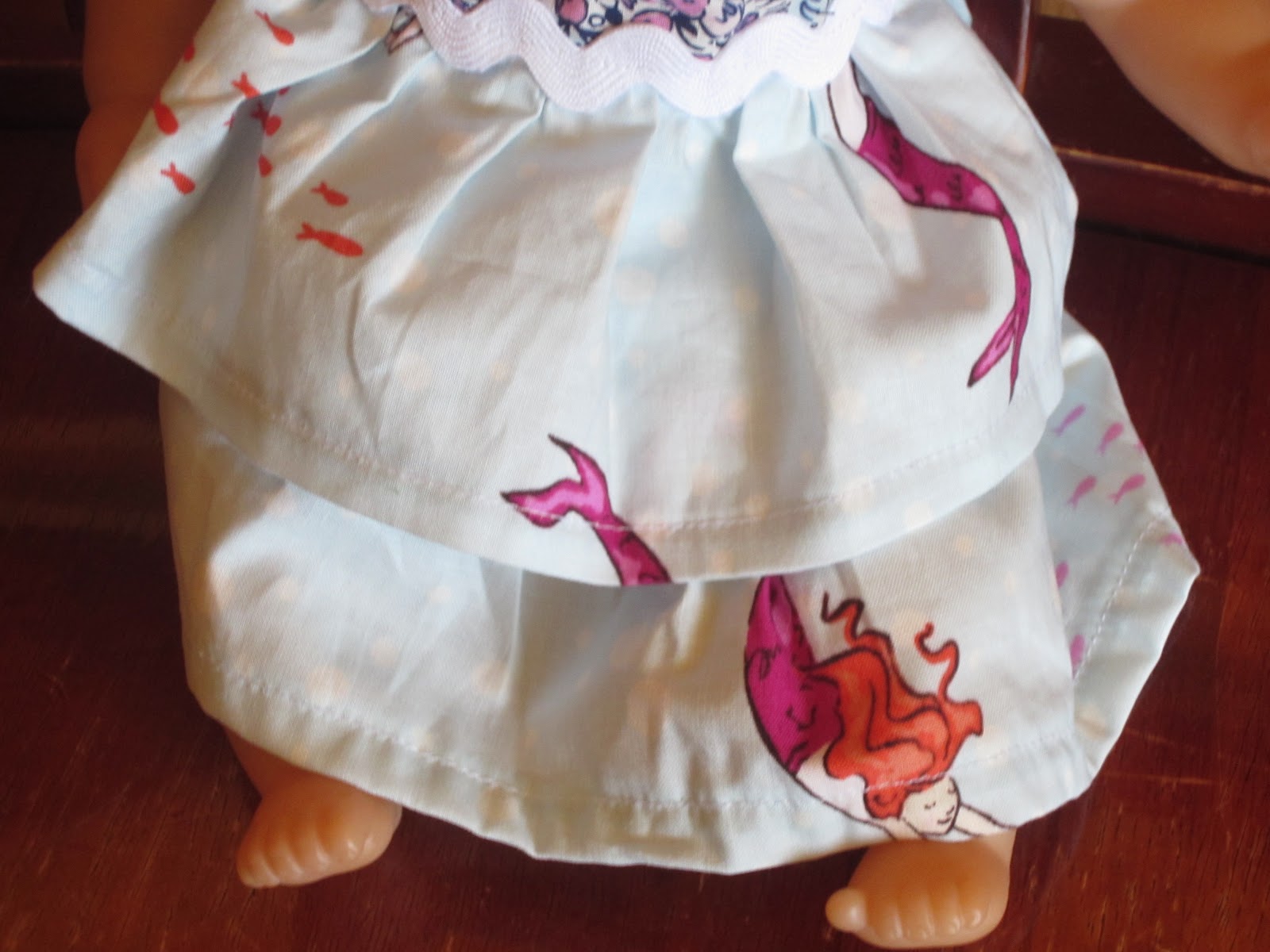
Yes, indeed, I also made a doll version! The pattern does not come with a doll version but I succeeded in figuring it out myself. I shrunk the pattern to 25% of scale. On my Mac, I did this by going to page setup and substituting 25% where it used to say 100%.  This turned out to be too small so I tried again with 35%.  Cutting out the pattern pieces and holding them up to Baby Pearl helped me figure this out.  I used the 6 mos size from the 35% scale pattern.  This worked great, except it was a tad too short.  No worries!  My 5 year old suggested an underskirt. Voila! This was a kinda fun thing to do except for the bias tape under the arms.  That was really really not fun at all!  If I do this pattern again for this doll, I will figure something else out. My tired hands!


Saturday, July 14, 2012

New Patterns!

I love buying new patterns and reading them and looking at them and thinking about them. LOL I don't sew from them as much as I do all the former activities!  But, I am planning for fall school clothes, so these will get used.

First of all, I decided to try some Mamu Designs patterns. I bought Nike and Arabella from Dotsnstripes on Etsy.   I chose the Arabella and Nike patterns.   They both arrived from the UK quite quickly! Faster than my fabric.com order!  (laughing)  I was so pleased to see each one has 20+ design options in just one pattern, plus numerous sizes! Considering the cost, that makes it worthwhile.


Nike looks to be a very useful pattern from which one can make numerous skirts, tops, and dresses. I love that the pattern can work with woven fabrics or knits and there are short sleeve, long sleeve, and no sleeve options, plus long and short skirts.  Very useful!


Arabella made me swoon!  The choices! Long and short ruffly dresses and tops.  28 variations. Plus, and wait for it........ doll patterns!  What could be better.  And, again, each design can be made with knits or wovens.

Mamu Designs are made in Germany but each pattern comes with English directions as well as a pattern map for tracing whatever size pattern you need.

Next up, new Ottobre! I love Ottobre. Such a wonderful resource.  If you have never bought one, here is some information about them. Ottobre is a pattern magazine designed in Finland. You can order a subscription from them directly and pay via payal.  You get a free issue when you do. They make four children's magazines a year and two women's collections. Each magazine comes with many patterns.  The current Fall 2012 children's issue has 40 patterns in it, for boys and girls, babies up to tweens, each one in a variety of sizes.  So, for about $15 an issue, you get a lot! You cannot sell the items you make from them (long story) but you can make a great deal of clothing for your children and grandchildren. Since they are ahead of the fashion styles in Europe, compared to us in the USA, I still sew from older Ottobres. In fact, my favorite year is 2006!

Here are some details.  This is the new issue:


You get a nice thick magazine with glossy pictures in inside, full of multiple photos for each pattern.  There are 5-10 patterns each for babies, girls, and boys, and tweens.


This is a diagram of each pattern included in this issue. Each one shows the size ranges for each pattern.  They are Euro sizes, but you can easily learn how to measure. Flip your measuring tape over to centimeters!


This is the scary part - the pattern map!  You get 2-4 of these, double-sided.  They have outlines of each pattern, multiple sizes. You trace the size you need. Each pattern has a different color so you can find it easily. It takes a bit of practice but once you get the hang of it, it is very easy. I use Swedish Tracing Paper to trace mine, which you can find on Amazon or Ebay.  
 Here is an up-close of a pocket.   You see how it shows each size, just like a standard pattern. You just trace it and cut it out. Very easy.

So, now to wait for my fabric to get here and figure out what to make with it. Stay tuned!


Sunday, June 3, 2012

Adjusting a pattern to fit an nonstandard size


 Welcome to post #2 in the Making your own patterns series.  In this post, I will show you how to take a pattern and adjust it to fit a body that is not standard sizing.  You might have a person who is a size 12 in the waist but 8 in height.  She might need a 10 in length of bodice but 8 in length of skirt.  So, what do you do? Here you go!!

 First of all, take very good measurements.  Measure chest circumference, waist circumference, from shoulder to waist, hip circumference, and waist to where you want hem to end. If your item has an empire or dropped waist, take that into account when you are measuring.  Draw it out if it helps you.  I prefer just to write it down, but drawing it out helps others a lot! 

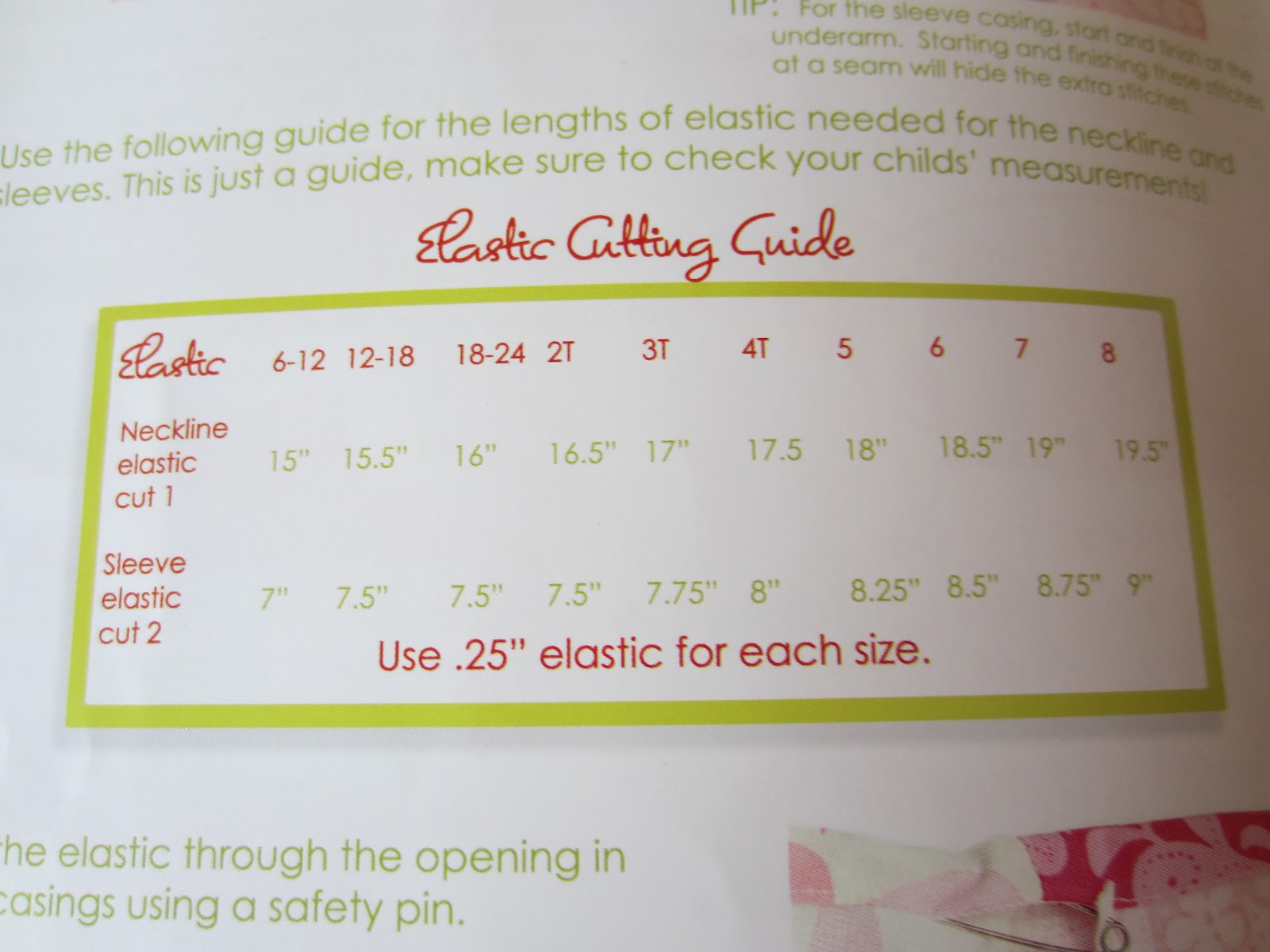
This might be hard to see, but here is the size chart for the Portabellopixie Claire pattern I use when I make a peasant dress.  It only goes up to size 8.  If you look closely, you can see that the waist sizes increase by increments of one half inch or three quarters of an inch. So I was able to size the pattern up pretty easily by taking good measurements.   The person I am sewing for has a 30" chest and needs the dress to be 32" from shoulder to hem.  This dress has a slightly empire waist and her waist measurement is also 30".  Because this is a dress with elastic around neckline, her shoulder width will not matter much.  The dress should still fit. 


 So, if you look closely at this picture,  you can see I added the appropriate increments to increase the pattern to a size 12 to accommodate her chest circumference.  I am keeping her shoulder to waist measurement in my head at the moment.


Another view.


Closeup
 

Fast forward to the sleeves, front ruffle and sash being all done! Back and front are sewn together. This girl measures 10 inches from shoulder to waist and I have made sure it fill fit that by adjusting as I sew.  In this case, I took a bit off the waist of the bodice before adding the sash, in order for it to be 10 inches from shoulder to waist.  Voila!
 

This girl is 30 inches around and this waist will measure 32 inches. Since it has a sash she can tie in back to make it fit better, this should fit perfectly!!
 

Now, for the elastic for the bodice neckline and sleeves.  As you can see below, there is one half inch between sizes for neckline elastic and one quarter inch between sizes for sleeve elastic.  So, it was easy to add up to what would be a size 12.  Because I would rather this be slightly loose than snug, I went with size 12 for elastic sizing, as that is also her waist size.
 
  
Elastic is all cut and ready to go.


Now, on to creating the skirt.  In this case, it is one piece with an attached ruffle.  This Children at Play Parade Print measures 14 inches so I needed another 7 inches or so to get to the 21-22 inches I need for the skirt.  I want the finished dress to measure 32 inches from shoulder to hem, and the bodice is 10 inches, so I need 21-22 inches.  And that is how I cut my fabric!  


All done!


Close up
 

Back view
 

Don't be afraid to play around with sizing on pdf patterns.  Paper patterns will be harder to adjust since the sizing is less standardized.  But, pdf patterns are usually pretty easy to adjust if you measure very carefully and write it all down, even draw it out.  You can do it! There is no such thing as a standard human body, anyway, so this really helps you sew in a more tailored way.

Happy sewing!

Sunday, May 27, 2012

Making your own patterns series!

Welcome to my new summer blog series, making your own patterns and extending the ones you have to fit larger sizes.  It is so simple to make your own basic patterns and extend the ones you have that I feel compelled to share.  I think this will be a lot of fun.  

I got the idea for this series by reading this book.  


Design-It-Yourself Clothes
Patternmaking Simplified
By Cal Patch

 Such a great book!  I love it so much I may have to buy it.  (I have it from the library at the moment.)  It offers great tips and advice and technical details about how to make your own patterns and design your own clothing. It is all simple clothing, to be sure, but still pretty darn cool and perfect for where I live, the Pacific Northwest.

So, starting tomorrow, I am going to show you how to alter your existing children's patterns and create your own patterns for yourself and your children.  This should be fun!

First up, taking a peasant dress pattern for baby girls thru size 8 and enlarging it to fit a size 10 or 12 girl and customizing it to her measurements. 


Monday, March 12, 2012

A fun new project!


This week (and a bit of last) I have undertaken a fun new project, to make a flutter-sleeved top similar to one sent to me by a customer.  Here is the original.


Here is a closeup of the top portion.  It has a square neckline, different from what I am used to sewing.  I have made several flutter-sleeve tops, most notably this one from a McCalls pattern and this one from TieDyeDiva. 
 This one has a square neckline so I had to modify the patterns to make this work. 


Here's my first attempt at a bodice.


 Here's my model.  It fits her well! 


Back View: 


 So, now on to trying it out with this fabric!